Thursday, 26 November 2009

Western Wall Tunnels

Sun 1 Nov
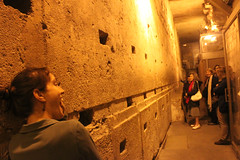
Deep under the Old City a 500 metre-long tunnel runs alongside the original foundations of the Western Wall, so its path, and much of the stonework, dates back 2000 years or more.

The slab in the picture is said to be one of the biggest bricks in the world, and you wonder where they got it from, how they got it here, how they cut it to size, and how they got it into place. The museum has a natty little film answering these questions, complete with cartoon workers pulleying pulleys, levering levers, and rolling logs.

At various points along the route various civilisations have built cisterns for the city's water supply, some of which are still there and in use. You can also see the different courses of stone set down during reconstructions of the Wall in different historical periods. At one point you stand on paving stones of a street laid in King Herod's time (over 2000 years ago); part of the passage follows the route of an aqueduct dating from the Hasmonean period around 100BC.

Part-way along you step through an arch in the stone into a small space provided with a couple of chairs. As we passed by there were a couple of women sitting deep in prayer, and another waiting her turn. When we came by on our way back 20 minutes later one of them was still there. This spot functions as a tiny synagogue, and is physically the closest any observant Jew can get to the Holy of Holies, at the heart of the ancient Temple, which lies on the other side of the Wall, within the Dome of the Rock mosque some 60 (?) metres away.

More Western Wall

Sun 1 Nov
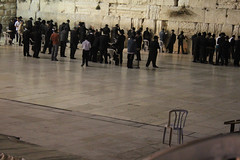
The Western Wall by night
The Western Wall has a special atmosphere at night - there are fewer tourists but the Orthodox groups keep coming, until at least 10pm. The square is quieter than during the day, but the murmur of prayer is still all-pervasive. The Wall is floodlit, and this light reflects across the square and casts strong shadows on the ground.

Mon 2 Nov
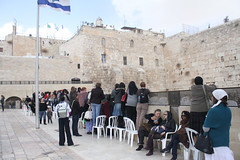
It's a Barmitzvah!
This is not normal behaviour - a line of women standing on chairs to get a view over to the men's area? The whole purpose of the separation of men and women for prayer is to avoid the possibility of distraction from the business in hand, and the temptation to think un-holy thoughts. Some kindly women made space so I could peep over, and all became clear - it's a Barmitzvah!

Wednesday, 25 November 2009

Western Wall

Sat 31 Oct

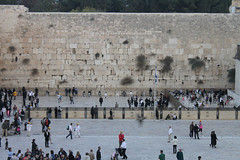
The Western Wall, in Hebrew the Kotel, is said to be the most significant site in the world for the Jewish people. It is the last remnant of the Temple, which was the focal point of Jewish worship in ancient times.

Belief
Jews believe that the creation of the world began on Mount Moriah, now known as Temple Mount, at a point marked by the Foundation Stone. The stone was enclosed in a space known as the Holy of Holies, which became the central point of the First and Second Temples.

History
King Herod undertook the expansion and renovation of the Temple, and in the course of this work built four massive walls around the whole Temple area. The Romans later destroyed the Temple and expelled the Jews, and during the early years of the spread of  Mohammedanism, the Muslims raised two mosques on the site, the golden-topped Dome of the Rock and the Al-Aqsa mosque. The Foundation Stone and the Holy of Holies are also venerated by Muslims, and are at the centre of the Dome of the Rock.

During the Six-Day War in 1967, the Israelis captured the whole of the city of Jerusalem, which they continue to administer. However they handed the Temple Mount, with its two mosques, over to a Muslim council. Non-Muslims can visit the Mount but are not allowed to enter the mosques, and the Israeli Rabbinate forbids Jews to enter the Temple Mount area at all.

The Wall today
Jews particularly venerate the Western Wall, as it is the closest point they can get to the Holy of Holies and the Foundation Stone. Men and women pray separately, as in a synagogue, with the women allocated a small area to the right of the men's space. Men must cover their heads, and a stall at the entrance hands out paper kippas to anyone who does not have their own.

The men pray individually or in groups; some of the Orthodox sects gather for prayer meetings at particular times, and seem to gravitate to wherever there appears to be sufficient space. People bring their holy books, and there are chairs, tables and a few bookstands available for anyone to use. Many go up to the Wall, press up against it, and speak or pray to it. All around there is the constant murmuring rise and fall of Jewish prayer, as each man recites the prayer in his own way, with his own emphases and at his own speed.

Some leave messages to the Almighty on folded pieces of paper in the gaps between the stones of the Wall. The bits of paper - called tzetel - are gathered up every now and then, but I don't know what happens to them then. You can even send a tzetel online :-)

A personal note
Although some family members of my own generation have visited Jerusalem and been to the Wall, I was very conscious that very few if any of my ancestors would have been able to. My grandparents on both sides came to the UK from Eastern Europe over 100 years ago; their families had probably been in Russia and Poland for several centuries, and before that had undertaken who knows how many generations of migration, from who knows where to who knows where. Every year during the Pesach celebrations they have expressed the wish to meet "next year in Jerusalem". So I touched the Wall for them.
Old City Souk

"Hello!"

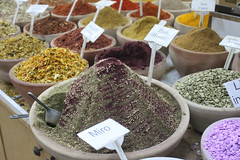
The Souk is a maze of mostly covered alleyways that criss-cross the heart of the old city. Every building is a stall, tempting your senses with a never-ending parade of spices, food, drinks, clothing, jewellery, lamps, tiles, ouds - and that's just in these pictures.

There's every colour in the rainbow, every culinary smell imaginable. You don't have to buy, but it's a constant challenge to resist.

"You're welcome!"

Church of the Holy Sepulchre

Sat 31 Oct

This, like most of the rest of Jerusalem, is a strange place. It is believed to be where Jesus died and was buried, and so is one of many major pilgrimage sites in the city. In its turn it houses several major Christian shrines. It struck me as a collection of disparate elements that seem to exist independently of each other, albeit in the same building.

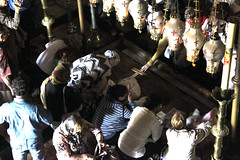
The first thing you see is a crowd of people on their knees, huddled round a stone slab. They are praying at the Stone of Unction, which commemorates the preparation of Jesus' body for burial. They touch the stone, rest their forehead, place a cross, or precious or personal item on it. Above it hangs a row of decorative lamps.

Just round the corner is the tomb of Christ, and nearby, up a stone staircase, are not one but two Calvaries. There are several other chapels, crypts and relics. A believer could spend a good deal of time in there. We only had 20 minutes, so we didn't join the queue for the tomb, and probably missed some other good bits. Here's some of the bits we did get to see.

Given the building's focus on a key part of the Christian story, it is only natural that most of the main Christian denominations feel they have a stake in it. It is jointly run by the Greek Orthodox, Armenian, and Roman Catholic Churches, and the Coptic, Syrian and Ethiopian Orthodox Churches are also represented. They all get along fine, especially the Greeks and Armenians, as attested in this news report.

....and Jan says
"Do you know the way to the Church of the Holy Sepultree?"

This is what an American asked me … I wonder why he thought it was pronounced this way? I didn’t ‘twig’ what he wanted to start with, but as Michael has said, it’s…. strange… but full of marvellous things. As a non-believer brought up on bible stories in Welsh Chapel, I have a curiosity which is more related to the ‘reality’ of people’s experience … and the question Why? I marvelled at the mosaic that shows Noah’s Ark on Mount Ararat, in the Armenian chapel, I loved the oil lamps and the incense as spectacle, I gawped at the queues of people waiting – under police control – to go into the holiest place, and frankly I was amazed at the plastic bags full of clothes that the East Europeans wiped in the rose oil on the slab. BUT I also did wipe a scarf and wore it! I was entranced by the Armenian chapel, and the Orthodox icons. I loved the lit candles, and I can completely understand the fighting in the YouTube video! Encompassing the CHS was the church of the Knights of St John, and the square of the five fountains – marvellous chicken sharwarma & falafel! 

Tuesday, 24 November 2009

Via Dolorosa

Sat 31 Oct  

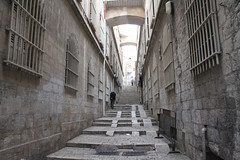
This street zig-zags across the Old City from Lions' Gate in the east to the Church of the Holy Sepulchre in the west. It is held to be the route taken by Jesus carrying the cross to his crucifixion, although modern archaeology suggests the historical route may have been a few metres away.

The route, which can only be a couple of kilometres long at most, now offers a kaleidoscope of cultures, religions and historical periods, too much to take in at one go. Rather like Israel itself, really. There are the stations of the cross (some marked by churches), and the prison Jesus is believed to have stayed in on his last night; there are Roman remains, medieval walls and an Arab cemetery.

And of course all the while you, the outsider, are passing through an old town going about its 21st century business, where Orthodox Jews stride through the covered Arab souk, Arab shopkeepers solicit your custom ("Hello!"), and Muslim mothers pushing prams stop to chat, each in their own world, oblivious of the others.

We managed to detach ourselves from the group at one point - even sat down for a coffee and baklava :-) - and were able to stop and look around, at our own speed. We had a street map, the Lonely Planet, and our cameras, and were in our element.

Mount of Olives

Sat 31 Oct  

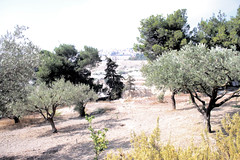
Well, it had to be a photo of olive trees, didn't it? In fact the Mount affords a series of quite stunning views of the city of Jerusalem on the hill opposite, with the golden Dome of the Rock always prominent, and also houses the most enormous cemetery you are likely to see anywhere in the world.

The Mount - Har Hazeitim in Hebrew - has been a holy place for Jews since Biblical times: the olive branch carried by the dove to Noah's Ark after the flood is said to have been plucked from the Mount, King David fled Jerusalem via the Mount, during the Temple periods ritual sacrifices were prepared there, and its olive oil was used to anoint kings and in Temple services. It was a place of pilgrimage, and on a more practical note, bonfires were lit there to announce the start of each new month.


Above all, it is the place from which Jews believe that, in the 'end of days', the Redemption of the Dead will begin. Hence its popularity as a burial place since the period of the First Temple - the closer you are to to the foot of the Mount, the sooner you will be redeemed. The cemetery was widely desecrated during the period 1948-1967, when the Jordanians held the West Bank. Since then the Israelis have restored some graves, and opened up the area for even more.

As you walk down the hill you come across a series of churches belonging to various Christian creeds - you can't miss the Russian onion spires - and at the bottom is the Garden of Gethsemane, where Jesus and the disciples prayed the night before the crucifixion. Some of the olive trees in the garden look old enough to have witnessed the scene.

However it is the cemetery that defines the Mount, as seen from both sides of the valley. The dead are all around you, awaiting their day.

How this blog works

Chronology
Some of the entries were posted while we were on the trip, others are being added now that we're back. The Timeline post lists entries in chronological order, so that you can follow the trip through from start to finish, if you are so inclined.

Navigation
The front page of the blog will always show the most recent postings, and will change as new posts are put up. At the end of a page of posts there is always a link to 'Older posts'. If you're looking for something specific, or just browsing, you can go to the Timeline, or use the sidebar (on the right):
  • Archive shows the Titles of all the posts in the blog
  • Topics collects together all posts that have some relevance to that particular topic (if we've remembered to label them properly . . . )
The sidebar also has a few links to external sites that do not necessarily appear in individual posts: News, views and background

To return to the current front page of the blog, click on the blog title 'Merkavah 09' at the top of any page.

To see a slideshow of photos relevant to a particular post, click on the photo at the head of the post, or on the word 'Slideshow' (clever, eh?).

We've also put a little slideshow in the sidebar, puerly for decorative purposes - at the moment it's showing some of our Jerusalem pictures.

Posts
The posts we sent up whilst we were in Israel were all based on photos taken with my mobile phone, which appeared to be the most convenient way to get it started. I sent these up from the phone to the Flickr photo site when we were somewhere with a Wifi connection, and added a brief comment. When I could get a few minutes on a computer I sent these Flickr pictures across to become posts in this blog. Now we're back we are gradually expanding and developing these posts, and adding other topics that didn't get posted at the time - sometimes because I just forgot to get the mobile out to take a quick snap!

Links
Most of the posts have (or will have . . . ) links to a slideshow of the relevant set of our photos on Flickr, and to anything that crops up in the post that we think might be worth linking to.

Photos
We're currently busily sorting through and editing the photos we took on our cameras, and uploading them to Flickr. Mine can be seen in this Merkavah 09 Collection - click on a thumbnail to see the photos in that particular set. The link on a blog photo, or on the word 'Slideshow', will take you straight to a slideshow of that set of photos - you can click on a link from there to take you to the individual photos.

Videos
We both shot a number of video clips, particularly of dances, and these will eventually find their way online, probably on YouTube; some may also appear here in the blog.